
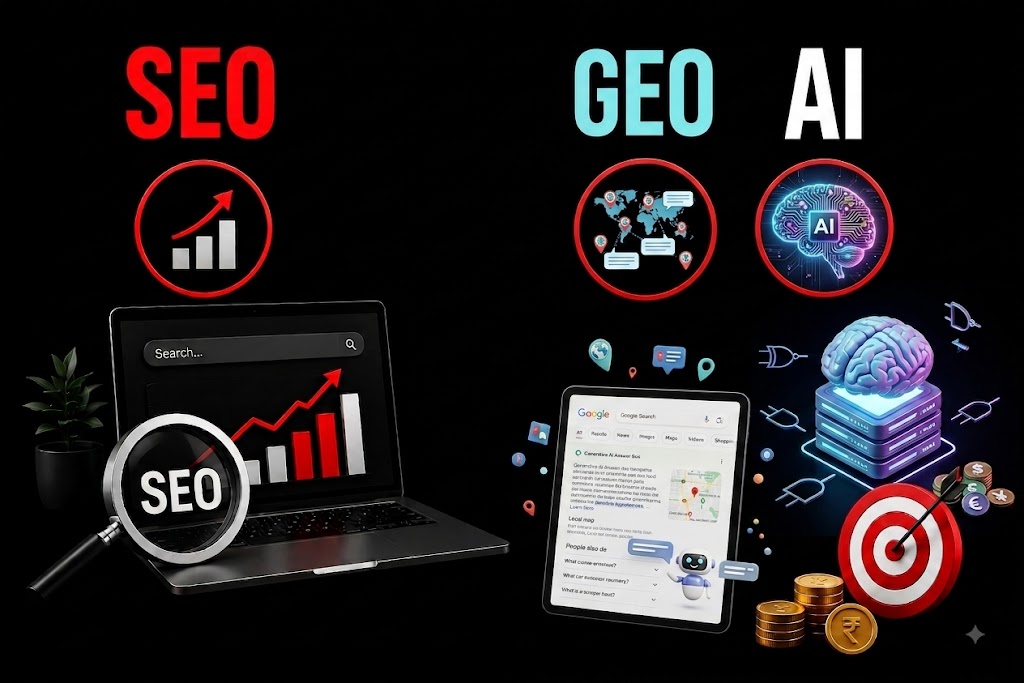
SEO vs GEO vs AI: What’s Changing in Search?
Introduction
Search is changing rapidly. For years, businesses focused mainly on Search Engine Optimization (SEO) to improve their visibility on Google and other search engines. Today, the way people discover information is expanding with the growth of Generative Engine Optimization (GEO) and AI-powered search. Instead of simply browsing a list of links, users can now receive direct answers, summaries, recommendations, and information generated by artificial intelligence. For businesses, this means that having a website is no longer enough. Brands need to create useful, trustworthy, and well-structured content that can be discovered through traditional search as well as AI-driven platforms.
Key Features of SEO, GEO, and AI Search
SEO focuses on improving a website’s visibility in traditional search engine results. It includes keyword optimization, technical SEO, quality content, backlinks, website performance, and user experience. The main goal is to help search engines understand a website and rank its pages for relevant searches.
GEO, or Generative Engine Optimization, focuses on improving the chances of a brand or website being referenced in AI-generated answers. Instead of optimizing only for a traditional list of search results, GEO emphasizes clear information, authoritative content, natural language, structured information, and strong brand credibility that AI systems can understand and use when generating responses.
AI is changing the search experience itself. AI-powered search tools can understand conversational questions, combine information from different sources, summarize complex topics, and provide more personalized answers. This means users may complete more of their research directly within an AI-powered search experience instead of clicking through multiple websites.
Benefits of SEO, GEO, and AI for Businesses
SEO remains valuable because search engines continue to help users discover websites, products, services, and businesses. A strong SEO strategy can generate organic traffic, improve online visibility, and create long-term opportunities for attracting potential customers.
GEO creates another opportunity for businesses to become visible when people ask AI systems questions related to their industry. If a business consistently publishes accurate, useful, and trustworthy information, its content has a better chance of becoming part of the information that AI systems can understand and reference.
AI-powered search can also improve the customer discovery journey. People can ask detailed questions in a conversational way and receive information that is easier to understand. For businesses, this creates an opportunity to provide genuinely helpful content that answers customer questions before they are ready to make a purchase.
The biggest benefit comes from combining these approaches rather than treating them as completely separate strategies. SEO can help a website remain visible in traditional search, while GEO and AI-focused content can help a brand adapt to new search experiences.
Limitations of SEO, GEO, and AI
SEO can take time to produce meaningful results, especially when a business operates in a competitive market. Search rankings can also change because of algorithm updates, competition, and changes in user behavior. This means SEO requires continuous monitoring and improvement.
GEO is still an evolving area. AI-generated search experiences can change quickly, and there is no guaranteed formula for making an AI system mention a particular business or website. Businesses should therefore focus on creating valuable and trustworthy content rather than trying to manipulate AI-generated answers.
AI search also has limitations. AI systems can sometimes provide incomplete, outdated, or inaccurate information. Businesses still need to maintain reliable sources, demonstrate expertise, and ensure that the information published on their websites is accurate and easy to verify.
Conclusion
The future of search is not simply about choosing SEO over GEO or AI. Instead, businesses need to understand how these three areas work together. Traditional SEO remains important for building search visibility, while GEO is becoming increasingly relevant as users turn to AI-generated answers. At the same time, AI is changing how people search, compare information, and discover businesses online. A strong digital marketing strategy should therefore focus on helpful content, technical quality, authority, trust, and a clear understanding of customer search intent. Businesses that adapt to these changes early can build a stronger and more sustainable presence across the evolving search landscape.
Want to learn more about digital marketing, SEO, GEO, and AI-driven search? Visit HeliyDigital at heylidigital.com.